
Every year, thousands of graduates — many of them engineers — find themselves torn between two very different paths: preparing for SSC CGL or chasing a corporate/IT career. Both are respected, both can build a solid life, and both come with trade-offs that rarely get discussed honestly. This guide skips the hype and gives you real numbers, real risks, and a framework to decide what actually fits you — not a universal "better" option, because there isn't one.
A quick disclosure: this comparison is written from the perspective of someone who prepared for SSC CGL while studying Computer Science Engineering, so it draws on that lived experience alongside publicly available salary and promotion data.
During my preparation, I realised many engineering students assume SSC is an easier alternative to placements. It isn't. The competition is different — you're up against graduates from every stream across the country, not just your branch — and the syllabus rewards a completely different kind of consistency than clearing coding rounds does. The opportunity cost of spending one or two years preparing is something every candidate should evaluate carefully, and it's rarely discussed honestly. That's exactly what the next section covers.
Figures throughout this article are indicative — always check the latest official notifications and company offers before deciding.
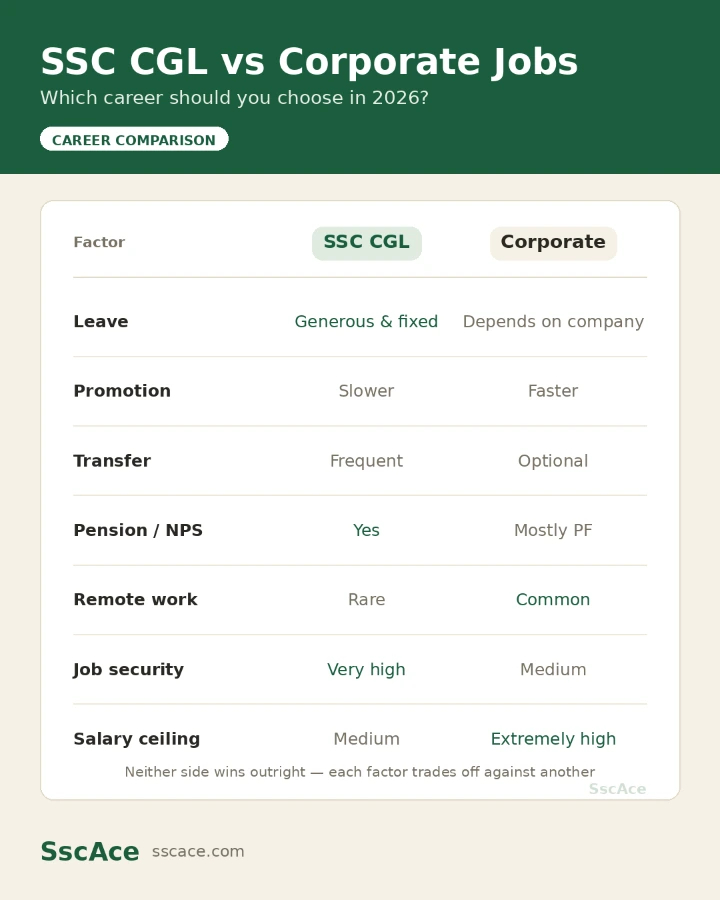
Quick Comparison: SSC CGL vs Corporate Jobs at a Glance
Before the detailed breakdown, here's the factor-by-factor snapshot most people actually want to screenshot and share:
1. Who Should Choose SSC CGL?
SSC CGL tends to be the stronger fit if you value predictability over fast-paced environment with uncertainities. It suits candidates who:
- Want a stable, pensioned-adjacent career with defined working hours in most posts.
- Prefer a fixed, transparent promotion ladder over performance-based, uncertain corporate growth.
- Are comfortable with the possibility of relocation/transfers as part of a central government posting.
- Want strong job security and don't want their role tied to market cycles, layoffs, or company performance.
- Are fine with a slower but steady salary curve rather than a volatile, high-ceiling one.
2. Who Should Choose Corporate / Software Jobs?
Corporate and IT roles are usually the better fit if you:
- Want faster early-career salary growth and are willing to trade stability for upside.
- Enjoy continuous skill-building and don't mind that your market value depends on staying current.
- Want flexibility to switch companies, cities, or even countries based on opportunity.
- Are comfortable with variable job security — layoffs and hiring freezes are real, not rare.
- Value remote/hybrid work options, which are far more common in tech than in government roles.
Understanding SSC CGL Exam Pattern
If SSC CGL sounds like your path after reading this, start with the exam structure and marking scheme before you plan your prep.
3. The Opportunity Cost Nobody Talks About
This is the part most SSC CGL content skips entirely. Preparing seriously takes real time — usually 1 to 2 years of focused effort — and that time has a price tag, even if no one writes you an invoice for it.
A concrete example:
If you're a CSE graduate capable of getting an ₹8–12 LPA job today, spending two years preparing for SSC CGL means giving up roughly ₹16–24 lakh of potential earnings during that window. That doesn't automatically make SSC a bad choice — the stability and long-term security it offers are real value too — but it's a real cost that should be weighed consciously, not ignored.
The opportunity cost isn't fixed — it depends heavily on how strong your alternative offer actually is. A few honest scenarios:
- If your realistic corporate alternative is a ₹3–5 LPA entry-level role, the opportunity cost of preparing is low, and SSC CGL's long-term stability likely outweighs it.
- If your realistic alternative is an ₹8–12 LPA product-based role, the opportunity cost is significant, and you should have a genuine, non-salary reason for choosing SSC (stability, family preference, risk tolerance) rather than defaulting into prep out of habit or peer pressure.
- If you can prepare part-time while still working — see our SSC CGL preparation strategy guide — you reduce this opportunity cost substantially, since you're not fully forgoing income during prep.
Very few articles run this calculation honestly, mostly because it's uncomfortable — nobody wants to tell an aspirant their two years of effort has a real financial cost attached. But making an informed decision means looking at this number, not avoiding it.
Subject-Wise Preparation Strategy for SSC CGL
Detailed strategy for preparing each subject efficiently with time allocation and resources.
4. Salary Progression: SSC CGL vs Corporate (5-Year Comparison)
The comparison below assumes an SSC CGL candidate joins a typical Pay Level 6–7 post (such as ASO, Inspector, Examiner, Preventive Officer or similar) in an X/Y class city, while the corporate employee starts as a Software Engineer in a company offering a package between ₹4–8 LPA. Actual salaries depend on the department, location, company, performance, promotions and future pay revisions.
| Experience | SSC CGL (Approx.) | Corporate / IT (Approx.) |
|---|---|---|
| Joining | Gross: ₹58k–₹72k/month In-Hand: ₹50k–₹65k/month | CTC: ₹4–8 LPA In-Hand: ₹28k–₹55k/month |
| After 2 Years | ₹54k–₹69k/month (Annual Increment + DA Revision) | ₹35k–₹80k/month (Depends on appraisal & job switch) |
| After 3 Years | ₹57k–₹73k/month | ₹45k–₹1.1L/month |
| After 5 Years | ₹62k–₹82k/month (Promotion/DA revisions may increase further) | ₹70k–₹2L+/month (High performers can earn considerably more) |
Important Context Before Comparing Salaries
- Corporate salaries have a much higher earning ceiling. Skilled professionals working in top product-based companies, multinational corporations, or AI/Software roles can earn ₹20–50 LPA or even more within a few years. Exceptional performers may reach these levels much faster through promotions and job switches.
- SSC CGL offers greater income stability. Government employees receive regular annual increments, Dearness Allowance (DA) revisions, House Rent Allowance (HRA), Transport Allowance (TA), National Pension System (NPS) benefits, paid leave, and strong job security.
- Corporate growth depends heavily on skills and performance. Learning new technologies, delivering strong results, switching companies, and working in high-demand domains can significantly increase salary. On the other hand, poor performance or layoffs can slow career growth.
- SSC CGL salary growth is more predictable. Promotions and pay revisions are generally structured and less dependent on individual performance, although promotion speed varies across departments and cadres.
- There is no universally better option. If your priority is job security, predictable income, and work-life balance, SSC CGL may be a better fit. If you're willing to continuously upskill, take risks, and aim for a much higher income, the corporate sector can offer significantly greater financial rewards.
SSC CGL 2026 Post Wise Salary
Complete SSC CGL 2026 post list with pay level, department, classification and age limit, plus in-hand salary of every post
5. Promotion Timelines
| Path | Typical Promotion Trigger | Approx. Time to First Promotion |
|---|---|---|
| SSC CGL | Seniority + vacancy-based, largely time-bound | 4–8 years (post-dependent) |
| Corporate/IT | Performance appraisal, manager discretion, market demand | 1.5–3 years (highly variable) |
Government promotions are slower but almost guaranteed if you stay. Corporate promotions can come faster, but they are not guaranteed — they depend on your manager, company growth, and how well you advocate for yourself.
6. Work-Life Balance, Transfers & Remote Work
SSC CGL
Generally fixed working hours and predictable holidays. However, many posts (especially Central Excise, Income Tax, CBI) involve periodic inter-state transfers, which can disrupt family life. Remote work is essentially non-existent.
Corporate/IT
Hours vary widely — some roles are 9-to-5, others involve crunches, on-call duty, or client-time zones. Hybrid and remote options are common in tech, offering flexibility government jobs rarely match, but "always-on" culture can hurt boundaries.
7. Job Security & Skill Growth
SSC CGL posts offer near-total job security — termination is rare and tied to serious misconduct, not business cycles. This comes with a trade-off: skill growth is slower, and the work itself is often process-driven rather than innovation-driven, which can make lateral moves outside government harder later.
Corporate/IT jobs, particularly in tech, force continuous upskilling just to stay relevant — new frameworks, tools, and expectations shift every few years. This builds a more transferable skill set but means your income is more exposed to layoffs, automation, and market downturns.
8. Tax & In-Hand Salary Notes
- Government salary: Basic pay + DA + HRA (or government accommodation) + Transport Allowance, taxed under standard slabs; NPS deductions apply to post-2004 recruits, reducing in-hand but building a retirement corpus.
- Corporate salary: CTC often includes bonuses, ESOPs, or variable pay that may not be guaranteed month-to-month; PF is standard, but retirement benefits are typically less structured than the NPS/pension framework.
- Always compare in-hand monthly salary, not just the headline CTC or Pay Level — corporate offer letters can overstate real take-home pay through variable components.
9. Real Risks of Both Paths
Risks of SSC CGL
Multi-year prep with no guaranteed selection; slower wealth accumulation early on; posting location is not your choice; career growth is capped by seniority, not ambition.
Risks of Corporate Jobs
Layoff risk during downturns; income can plateau or decline if skills go stale; health and burnout risks in high-pressure roles; no pension — retirement planning is entirely on you.
10. Which Path Fits Which Student? (Example Profiles)
- The risk-averse graduate from a small town: Values stability, family proximity after settling, and social respect associated with a government post — SSC CGL is often a strong fit.
- The CSE/engineering student with strong coding skills: Has a faster, higher-upside path in tech, and the opportunity cost of 1–2 years solely preparing for SSC CGL may be high — corporate is often the stronger near-term choice.
- The graduate unsure of their core skill or interest: The SSC CGL syllabus is structured enough to be a good forcing function, and the qualification opens multiple department options without needing a specialised skill set.
- The ambitious generalist open to relocation and grind: May do well in corporate roles that reward initiative and fast learning, especially if willing to switch companies for growth.
11. Common Myths, Corrected
- Myth: "Government jobs are always stress-free." Reality: workload varies by department and posting; audit seasons, fieldwork roles, and public-facing posts can be demanding too.
- Myth: "Corporate jobs always pay more." Reality: only true at the higher end; many entry-level corporate roles, especially in services companies, pay less than a Pay Level 4–6 SSC CGL post once benefits are factored in.
- Myth: "You can't switch from government to corporate later." Reality: harder, not impossible — some skills transfer, but the gap tends to widen the longer you stay in a process-heavy government role.
Decision Framework
Instead of asking "which is better," ask: (1) How much am I willing to trade early income for long-term security? (2) Do I enjoy structured, process-driven work or fast-changing, skill-driven work? (3) How important is location stability to me? (4) Can I financially and mentally sustain 1–2 years of SSC CGL prep without full-time income? Score each honestly — your answers, not internet opinions, should decide your path.
Frequently Asked Questions (FAQs)
Is SSC CGL still worth it in 2026 with rising IT salaries?
Yes, for candidates who prioritise stability and structured growth. It's less "worth it" purely on salary if your goal is maximum early-career earnings in a booming tech niche.
Can a working professional prepare for SSC CGL alongside a job?
Yes, many candidates do, though it requires disciplined time-boxing — typically 2–3 hours daily over 8–12 months, with intensive revision closer to the exam.
Does SSC CGL offer any tech-adjacent roles?
Some posts involve data and systems work, but SSC CGL roles are largely administrative, auditing, or enforcement-focused rather than software development roles.
Should I quit my corporate job to prepare full-time?
Generally not recommended unless you have 8–12 months of expenses saved. Most successful candidates prepare part-time first and only consider a short full-time sprint before the exam if truly necessary.
Is SSC CGL better than a software engineer job?
Neither is universally "better." SSC CGL wins on stability, pension, and predictability; software roles win on salary ceiling and skill growth. The right answer depends on your risk tolerance, not a ranking.
SSC CGL vs TCS — which is the smarter choice?
A Pay Level 6–7 SSC CGL post often out-earns an entry-level TCS package in-hand, but TCS offers faster skill exposure and city flexibility. If long-term stability matters more to you than early salary, SSC CGL edges ahead here.
SSC CGL vs Infosys — how do they compare?
Similar trade-off to TCS: Infosys may offer marginally better growth for high performers and onsite opportunities, while SSC CGL offers guaranteed job security and a pension-linked retirement — service-sector IT roles rarely match that.
Is SSC CGL a good option after BTech?
Yes, it's a common and valid path — many BTech graduates choose SSC CGL for stability. Just weigh the opportunity cost outlined above before committing 1–2 years to preparation instead of applying for engineering roles.
Should engineers specifically prepare for SSC CGL?
Only if the trade-offs in this article genuinely appeal to you — stability, structured growth, and job security — rather than as a fallback because placements feel uncertain.
Can I prepare for SSC CGL while working a full-time job?
Yes — it's the lower-opportunity-cost path discussed above. It takes discipline (2–3 focused hours daily) but avoids giving up income entirely during preparation.
Still deciding? Our beginner's study guide walks through exactly how to start if you choose the SSC CGL path.