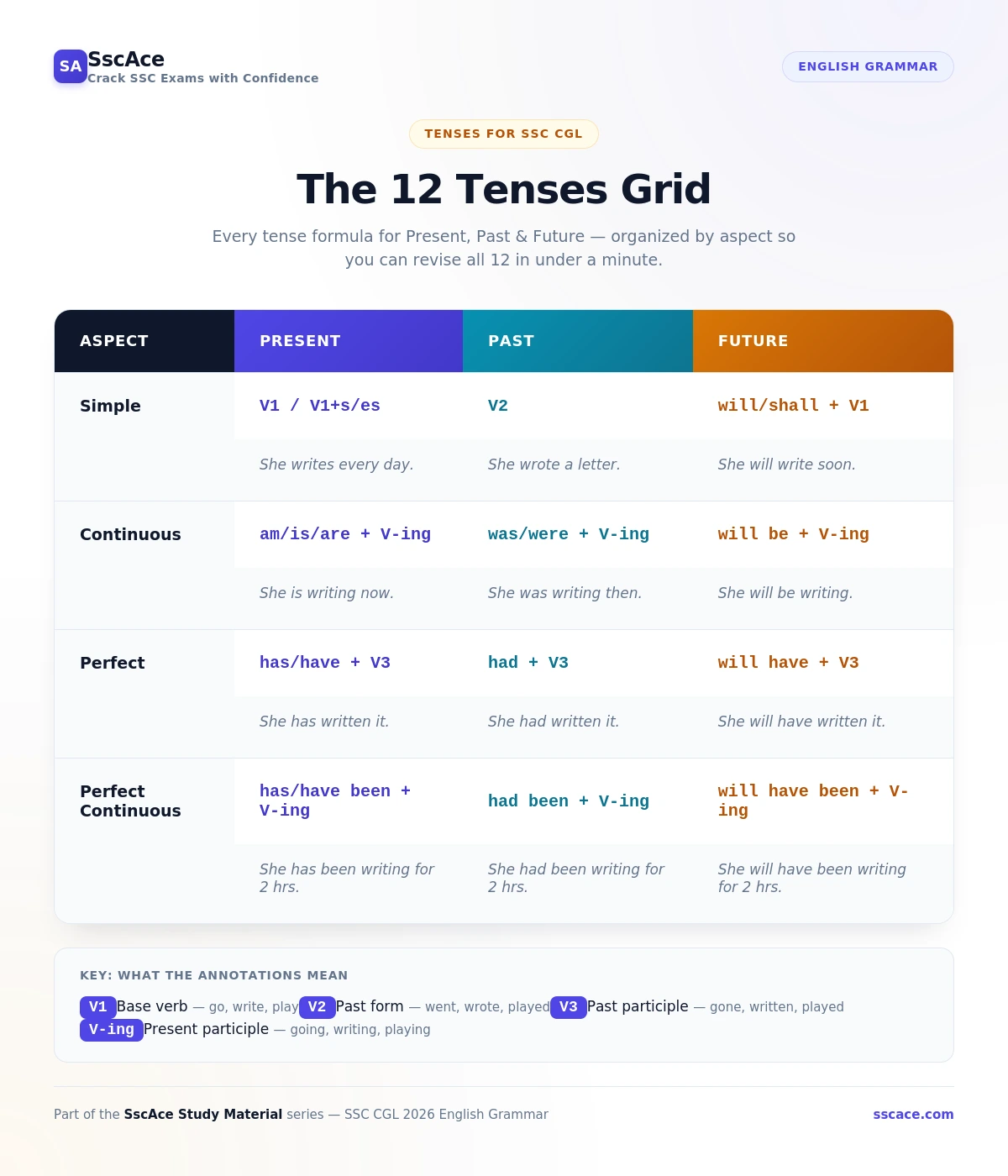
Tenses form the backbone of the SSC CGL English section. Whether it's Error Spotting, Sentence Improvement, Fill in the Blanks, or Cloze Test, a solid grip on all 12 tenses is what separates candidates who guess from candidates who score. This guide breaks down every tense — Present, Past, and Future — with simple formulas, exam-relevant examples, SSC-specific tricks, frequently made mistakes, and 17 interactive quizzes so you can test yourself before the real exam.
By the end of this guide, you'll understand all 12 English tenses, avoid the most common SSC grammar mistakes, and solve tense-based Error Spotting questions with confidence.
Subject-Verb Agreement & Active Passive Voice for SSC CGL 2026
Once your tenses are strong, master these two other high-weightage grammar topics with rules, tricks, and interactive quizzes.
What are Tenses?
A tense is the form a verb takes to show when an action happens — in the present, the past, or the future. English has three main time frames, and each one splits into four aspects (Simple, Continuous, Perfect, and Perfect Continuous), giving us a total of 12 tenses.
SSC CGL 2025: ALL Antonym-Synonym and Idioms and Phrases PDF Free
Download the free SscAce SSC CGL 2025 Tier 1 English handbook — 100+ synonyms & antonyms, 66 idioms, and 1 homonym with meanings, all in one PDF.
NOTE :- Keep the rule grid in above image(shown in the starting) in front of you while you read the rest of this guide — every rule below is simply one cell of this table explained with SSC-relevant examples.
Part 1: Present Tenses (4 Types)
The Present tense doesn't only talk about "now" — SSC loves testing habitual actions, ongoing actions, and actions with present relevance, all in this category.
1. Present Simple
Formula: Subject + V1 (+s/es for third person singular)
Use: Habits, facts, routines, general truths.
Example: The sun rises in the east. She goes to office by metro.
Choose the correct sentence.
2. Present Continuous
Formula: Subject + am/is/are + V-ing
Use: Action happening right now, or a fixed future arrangement.
Example: She is preparing for the SSC CGL exam. We are meeting the director tomorrow.
Choose the correct sentence for an action happening right now.
3. Present Perfect
Formula: Subject + has/have + V3
Use: Action completed at an unspecified time, but with a result relevant to the present.
Example: They have submitted the application. He has already left for the exam centre.
Choose the correct sentence.
4. Present Perfect Continuous
Formula: Subject + has/have been + V-ing
Use: Action that started in the past and is still continuing, often with "for" or "since."
Example: I have been preparing for SSC CGL since January. He has been working here for three years.
Choose the correct sentence.
Present Tenses: Quick Recap
Simple = habits & facts. Continuous = happening right now. Perfect = done, result matters now. Perfect Continuous = started in the past, still going on. In the next part, we move to the four Past tenses, SSC-specific tricks, and the most common mistakes students make.
Part 2: Past Tenses (4 Types)
Past tenses describe completed or ongoing actions before the present moment. SSC frequently tests the difference between Simple Past and Past Perfect when two past actions appear in the same sentence.
5. Past Simple
Formula: Subject + V2
Use: A completed action at a definite time in the past.
Example: He submitted his form last week. The result was declared yesterday.
Choose the correct sentence.
6. Past Continuous
Formula: Subject + was/were + V-ing
Use: An action in progress at a specific past moment, often interrupted by another action.
Example: I was solving mock tests when the power went out.
Choose the correct sentence.
7. Past Perfect
Formula: Subject + had + V3
Use: The earlier of two past actions — it happened before another past action.
Example: The train had already left when I reached the station.
Choose the correct sentence.
8. Past Perfect Continuous
Formula: Subject + had been + V-ing
Use: An action that had been continuing for some time before another past action occurred.
Example: He had been working on the report for two hours before his laptop crashed.
Choose the correct sentence.
SSC Tricks for Past Tenses
- "Before" and "after" often signal Past Perfect.Regardless of which clause comes first in the sentence, the action that happened earlier takes 'had + V3,' and the later action stays in Past Simple.
- "By the time", "till", "until" commonly pair one Past Perfect clause with one Past Simple clause.
- Identify irregular V2/V3 forms in advance. Common SSC favorites: go–went–gone, see–saw–seen, take–took–taken, write–wrote–written, begin–began–begun.
- Never mix "since/for" with Past Simple alone when continuity matters — check whether Past Perfect Continuous is really needed instead.
Common Mistakes with Past Tenses
- Using Past Simple for both past actions when one action clearly happened before the other. ("When I reached, the meeting finished" should be "... the meeting had finished.")
- Confusing V2 and V3 forms of irregular verbs — e.g., writing "had wrote" instead of "had written."
- Dropping "been" in Perfect Continuous forms — writing "had waiting" instead of "had been waiting."
- Using "since" with a duration instead of a starting point — "for three years" is correct, "since three years" is not.
Past Tenses: Quick Recap
Simple = one completed past action. Continuous = an ongoing past action, often interrupted. Perfect = the earlier of two past actions. Perfect Continuous = a duration before another past action. Next, we cover the four Future tenses, five mixed SSC-level quizzes, and a complete preparation strategy.
Part 3: Future Tenses (4 Types)
Future tenses describe actions that haven't happened yet. SSC often tests these alongside time clauses like "when," "before," and "by the time," where the tense rules can be counter-intuitive.
9. Future Simple
Formula: Subject + will/shall + V1
Use: A simple prediction or decision made at the moment of speaking.
Example: I will call you after the exam. The result will be declared next week.
Choose the correct sentence.
10. Future Continuous
Formula: Subject + will be + V-ing
Use: An action that will be in progress at a specific future time.
Example: This time next week, I will be sitting in the exam hall.
Choose the correct sentence.
11. Future Perfect
Formula: Subject + will have + V3
Use: An action that will be completed before a specific point in the future.
Example: By next year, she will have finished her graduation.
Choose the correct sentence.
12. Future Perfect Continuous
Formula: Subject + will have been + V-ing
Use: An action that will have been continuing for a duration up to a specific point in the future.
Example: By next month, he will have been preparing for SSC CGL for two full years.
Choose the correct sentence.
Future Tenses: Quick Recap
Simple = a plain future prediction. Continuous = in progress at a future moment. Perfect = completed before a future deadline. Perfect Continuous = a duration running up to a future deadline. Remember: inside time clauses ("when," "if," "before," "as soon as"), drop "will" and use Present tense instead.
Mixed SSC-Level Practice: 5 Tenses Together
Real SSC CGL questions rarely test one tense in isolation — they mix Present, Past, and Future forms in the same sentence, or hide the error inside a clause. Attempt these five mixed-level questions to simulate the real exam.
Spot the error: "If it will rain tomorrow, we will cancel the picnic."
Spot the error: "She is knowing the answer to this question."
Choose the correctly formed sentence.
Spot the error: "No sooner he reached the station than the train left."
Choose the correctly formed sentence.
Preparation Strategy: How to Master All 12 Tenses for SSC CGL
1. Learn the Grid, Not Just Rules
Memorize the 3x4 tense grid (Present/Past/Future x Simple/Continuous/ Perfect/Perfect Continuous) from the top of this guide. Once the structure is automatic, applying it to any new sentence becomes fast and reliable.
2. Master Time-Clause Words
Words like when, if, before, after, by the time, and as soon as change how tenses combine across a sentence. SSC repeatedly tests these — drill them separately from the basic tense rules.
3. Build a V1-V2-V3 List
Keep a running list of the 50 most common irregular verbs (go-went-gone, write-wrote-written, etc.) and revise five new ones daily until they become second nature.
4. Practice Mixed Questions
Don't only practice one tense at a time. Solve previous year Error Spotting and Sentence Improvement questions that mix multiple tenses, exactly like the real exam does.
Why This Topic Matters
Tense-based errors appear consistently across SSC CGL, SSC CHSL, and SSC MTS English papers, spanning Error Spotting, Sentence Improvement, Fill in the Blanks, and Cloze Test sections. Since tenses follow fixed, learnable formulas rather than vocabulary that must be memorized word by word, this is one of the highest-return topics you can prepare in the English section.
Frequently Asked Questions
How many tenses are asked in SSC CGL Tier 1 and Tier 2?
There is no fixed number, but tense-based Error Spotting and Sentence Improvement questions appear in almost every SSC CGL English paper, usually across 3-6 questions per tier, making this one of the most consistently tested grammar topics.
Which tense is most important for SSC CGL?
Present Perfect, Past Perfect, and Future Perfect are the most frequently tested because they involve tricky time-clause rules ("since/for," "before/ after," "by the time") that are easy to get wrong under exam pressure.
How can I quickly identify the correct tense in an Error Spotting question?
Locate any time markers first (yesterday, since, by next year, when, before). These markers almost always point directly to the required tense, so decode the time marker before checking the verb form.
Do stative verbs like know, want, and believe ever take continuous forms?
Rarely, and SSC exams stick to the standard rule: stative verbs are not used in continuous tenses. Treat "is knowing," "is wanting," and "is believing" as errors unless the exam explicitly signals an unusual, non-standard usage.