Percentage is one of the most important concepts in SSC CGL Mathematics. It appears directly in percentage questions and indirectly in Profit & Loss, Discount, Simple & Compound Interest, Population, Data Interpretation, and Ratio. Instead of memorising dozens of formulas, this guide helps you learn the core ideas and understand how they connect — with interactive mini quizzes after every major concept so you can test yourself before the real exam.
SSC CGL Mock Test Strategy: How to Practice Effectively
Discover how often to take mock tests, how to analyse your mistakes, and build real exam readiness.
1. What is Percentage?
The word percentage means "per hundred." The symbol used for percentage is %.
x% = x / 100
For example:
- 50% = 50/100 = 1/2
- 25% = 25/100 = 1/4
- 75% = 75/100 = 3/4
Percentage simply represents a quantity out of 100.
Percentage, Fraction & Decimal
The same value can be represented in three forms. For example:
- 50% = 1/2 = 0.5
- 25% = 1/4 = 0.25
- 75% = 3/4 = 0.75
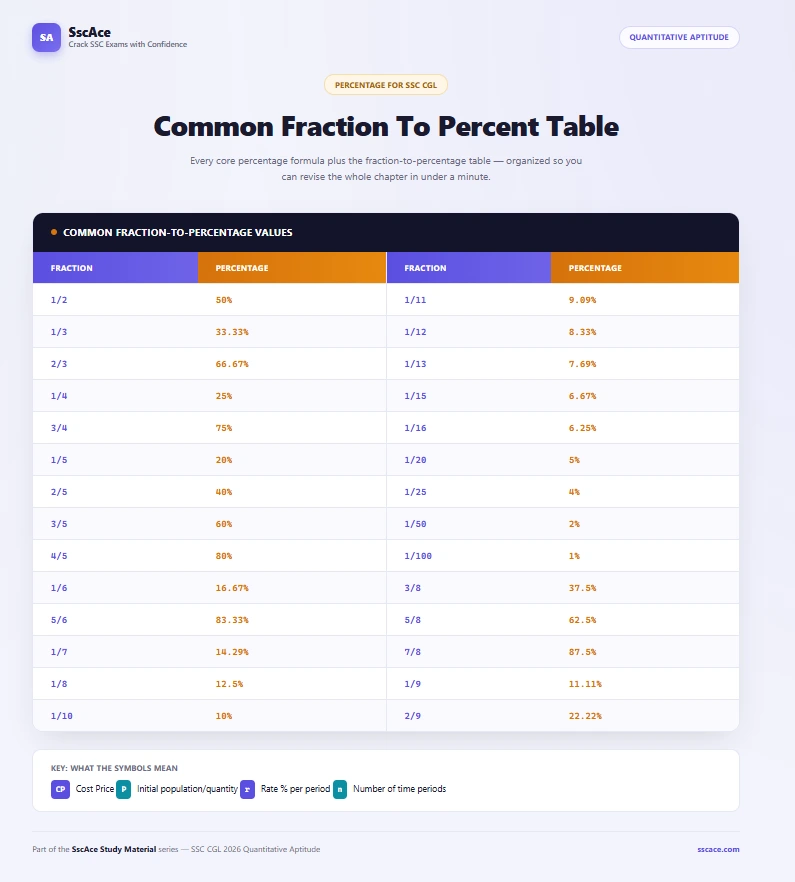
This conversion is extremely useful in SSC because fractions are often faster to calculate with than percentages.
2. Percentage Conversions
Fraction → Percentage
Multiply the fraction by 100.
Percentage = Fraction × 100
Example: Convert 3/4 into percentage → 3/4 × 100 = 75%. Another example: 5/8 × 100 = 62.5%.
Percentage → Fraction
Write the percentage over 100 and simplify.
x% = x / 100
Example: 40% = 40/100 = 2/5. And 12.5% = 12.5/100 = 1/8.
Decimal → Percentage
Multiply by 100. Examples: 0.5 = 50%, 0.75 = 75%, 1.25 = 125%.
SSC Tip
You don't need to memorise every value in the table. Prioritise 50%, 25%, 20%, 10%, 12.5%, 33⅓%, 66⅔%, 37.5% and 75% — these frequently make mental calculations much faster.
What is 37.5% as a fraction?
What percentage is 5/8?
3. Basic Percentage Calculations
There are three basic types of percentage questions.
Type 1: Find x% of a number
x% of y = (x × y) / 100
Example: Find 20% of 500 → (20 × 500)/100 = 100.
⚡ Faster method: 20% = 1/5, so 500 ÷ 5 = 100. No multiplication required.
Type 2: Find what percentage one number is of another
Percentage = (Part / Whole) × 100
Example: 25 is what percentage of 200? → (25/200) × 100 = 12.5%.
Type 3: Find the original number
Original Number = (x × 100) / y
Example: 60 is 15% of a number → (60 × 100)/15 = 400. Verification: 400 × 15% = 60. Correct.
What is 15% of 650?
45 is 18% of which number?
4. Percentage Increase & Decrease
This is one of the most important applications of percentage.
Percentage Increase
% Increase = ((New − Original) / Original) × 100
Example: Salary increases from ₹20,000 to ₹25,000. Increase = ₹5,000. Percentage increase = (5000/20000) × 100 = 25%.
Percentage Decrease
% Decrease = ((Original − New) / Original) × 100
Example: Price decreases from ₹500 to ₹400. Decrease = ₹100. Percentage decrease = (100/500) × 100 = 20%.
The Most Important Rule
Percentage change is always calculated using the original value as the base — never the new value. For ₹100 → ₹120, the increase is ₹20, so the percentage increase is (20/100) × 100 = 20%, not (20/120) × 100.
Finding the New Value After a Percentage Change
After x% increase: New Value = Original × (100 + x)/100
After x% decrease: New Value = Original × (100 − x)/100
Example: 800 increases by 25% → 800 × 125/100 = 1000. Example: 1200 decreases by 20% → 1200 × 80/100 = 960.
A salary increases from ₹20,000 to ₹25,000. What is the percentage increase?
A number is increased by 25%. If the original number is 800, what is the new value?
5. Successive Percentage Changes
Suppose a value changes by two percentages one after another. You cannot simply add the percentages because the second percentage is calculated on the already changed value. For two successive changes x% and y% (treat increases as positive and decreases as negative):
Net Change = x + y + (xy / 100)
Example 1: Two Increases
Price increases by 10% and then 20% → 10 + 20 + (10×20)/100 = 32% net increase.
Example 2: Increase Followed by Decrease
Population increases by 20% and then decreases by 10% → 20 − 10 + (20×−10)/100 = 8% net increase.
Example 3: Decrease Followed by Increase
Price decreases by 25% and then increases by 25% → −25 + 25 + (−25×25)/100 = 6.25% net decrease.
Equal Increase and Decrease
If a value increases by x% and then decreases by the same x%, the net effect is always a decrease of x²/100 percent. For 20%: 20²/100 = 4% decrease. It never returns to the original value.
A number increases by 10% and then by 20%. What is the net increase?
A number increases by 20% and then decreases by 20%. What is the net change?
A price decreases by 25% and then increases by 25%. What is the final change?
6. Reverse Percentage
Sometimes a value changes by a percentage and the question asks: what percentage change is required to return to the original value? The answer is not the same percentage.
If a Value Increases by x%
Required decrease = (x / (100 + x)) × 100
Example: Price increases by 25% → required decrease = (25/125) × 100 = 20%. Verification: 100 → 125 (after +25%) → 125 − 20% of 125 = 125 − 25 = 100. Correct.
If a Value Decreases by x%
Required increase = (x / (100 − x)) × 100
Example: Salary decreases by 20% → required increase = (20/80) × 100 = 25%.
🧠Remember: for an increase, the required decrease uses the larger denominator (100 + x); for a decrease, the required increase uses the smaller denominator (100 − x).
A price increases by 40%. What percentage decrease is required to bring it back to its original value?
A salary decreases by 20%. What percentage increase is required to restore the original salary?
7. Percentage + Population
Population questions are essentially successive percentage-change questions. If population increases by the same rate r% every year:
P(final) = P × (1 + r/100)â¿
where n = number of years. For a decrease of r% per year:
P(final) = P × (1 − r/100)â¿
Example: Population 10,000 grows at 5% for 2 years → 10000 × (1.05)² = 11,025.
The population of a town is 8,000. It increases by 10% per year. What will it be after 2 years?
A population of 10,000 decreases by 10% every year. What will it be after 2 years?
8. Percentage + Profit & Loss
Percentage is also the foundation of Profit & Loss. CP = Cost Price, SP = Selling Price.
Profit% = (Profit / CP) × 100
Loss% = (Loss / CP) × 100
Example: CP = ₹800, SP = ₹960. Profit = ₹160. Profit% = (160/800) × 100 = 20%.
SP after p% profit = CP × (100 + p)/100
SP after p% loss = CP × (100 − p)/100
Example: CP = ₹2,000, Loss = 15% → SP = 2000 × 85/100 = ₹1,700.
SSC Trap
Profit percentage is always calculated on CP, never on SP. If CP = ₹100 and SP = ₹120, profit = ₹20, so profit% = 20% (using CP as base).
An article bought for ₹1,200 is sold for ₹1,500. Find the profit percentage.
An article is sold at a 15% loss. If CP = ₹2,000, find SP.
9. Percentage Point vs Percentage Increase
This is a subtle but important distinction. Suppose marks increase from 40% to 50%. The percentage-point increase is 50 − 40 = 10 points. But the relative percentage increase is (10/40) × 100 = 25%.
So: 40% → 50% is a 10 percentage-point increase, but a 25% relative increase. Don't confuse the two.
A student's score increases from 60% to 75%. What is the relative percentage increase?
âš¡ SSC Percentage Shortcuts
10% and 5%
For 10%, simply divide by 10. For 5%, find 10% and halve it. 10% of 450 = 45; 5% of 600 = 60 ÷ 2 = 30.
50%, 25% and 20%
50% = divide by 2, 25% = divide by 4, 20% = divide by 5. 50% of 840 = 420; 25% of 800 = 200; 20% of 750 = 150.
12.5% and 75%
12.5% = divide by 8: 640/8 = 80. 75% = find 3/4: 800 × 3/4 = 600.
Swap Percentage
x% of y = y% of x. So 16% of 25 becomes 25% of 16 = 4 — very useful for mental calculations.
âš ï¸ Common SSC Percentage Mistakes
- Adding successive percentages directly: 10% + 20% is not 30%. The correct answer is 32% increase.
- Assuming equal increase and decrease cancel out: A 20% increase followed by a 20% decrease is not 0% — it is a 4% decrease.
- Using the wrong base: Percentage increase/decrease always uses the original value as the base, not the new value.
- Using SP instead of CP for Profit%: Profit percentage is always calculated on the Cost Price.
- Treating reverse percentage as the same percentage: A 25% increase requires a 20% decrease to reverse, not 25%.
- Confusing percentage points with percentage increase: 40% → 50% is 10 percentage points, but a 25% relative increase.
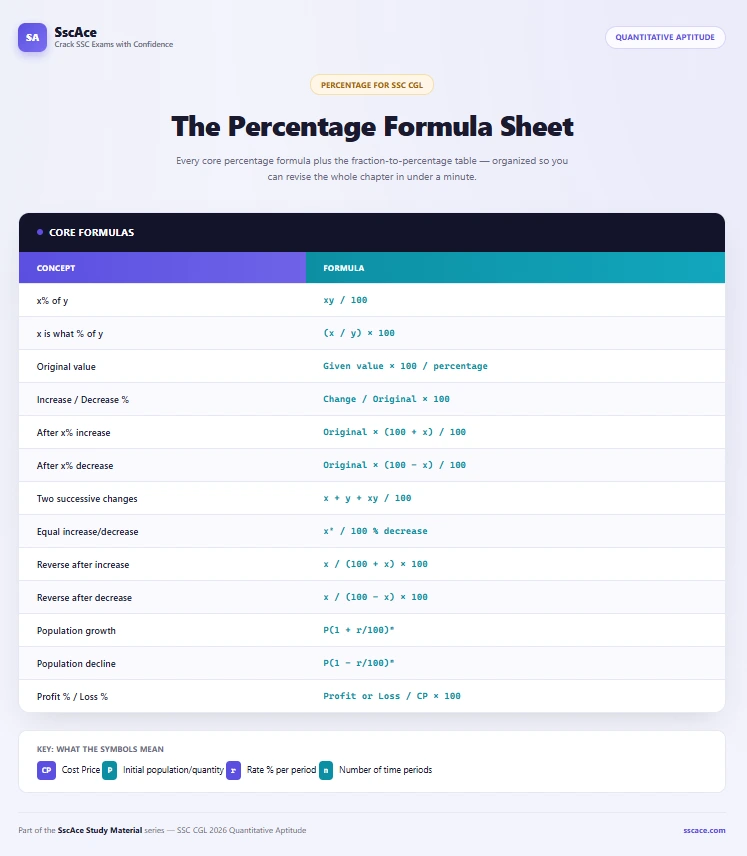
🧠Percentage Formula Sheet
🆠Final Percentage Revision Quiz
You've now covered the complete module. Don't look back at the formulas — try these mixed questions first.
What is 12.5% of 640?
45 is what percentage of 180?
A number increases by 20% and then decreases by 20%. What is the net change?
A price increases by 40%. What percentage decrease will restore the original price?
A population of 8,000 grows by 10% annually. What will it be after 2 years?
An article costing ₹1,200 is sold for ₹1,500. Find the profit percentage.
A number increases by 30% and then decreases by 10%. Find the net change.
A salary decreases by 20%. What percentage increase is needed to restore the original salary?
Marks increase from 40% to 50%. What is the relative percentage increase?
If 40% of A = 60% of B, then A : B is:
How to Prepare Percentage for SSC CGL
Don't try to memorise this entire article. Use this progression instead:
1. Learn
Understand the flow: Percentage → Change → Successive Change → Reverse Percentage. Concepts build on each other.
2. Memorise
Learn the common fraction-percentage conversions and the basic shortcuts by heart.
3. Practice
Solve questions covering different patterns rather than solving 20 identical questions in a row.
4. Analyse & Attempt PYQs
When you get a question wrong, identify the exact concept that caused it. Once concepts are clear, move to actual SSC previous-year questions.
Why This Topic Matters
Percentage underlies Profit & Loss, Simple & Compound Interest, Population, Data Interpretation, and Ratio questions across SSC CGL Tier 1 and Tier 2. Mastering this one concept meaningfully boosts your Quantitative Aptitude score across multiple topics at once.